Managed IT services solve real problems for growing businesses, but they aren't a silver bullet — and the sales conversation rarely covers the honest tradeoffs. Here are the risks you should evaluate before signing, along with the specific diligence questions and contract terms that filter out most of them.
This is a post an MSP shouldn't really want to write. But not writing it doesn't make the risks disappear — it just means clients discover them the hard way, usually 18–24 months in when the relationship is already entrenched and the switching cost is high. The businesses that get the most from managed services relationships are the ones that went in with clear eyes about what could go wrong.
Every risk below is real, has cost real businesses real money, and is mitigatable through the right contract language and selection criteria. None of them are reasons to avoid managed services. They're reasons to be a discerning buyer.
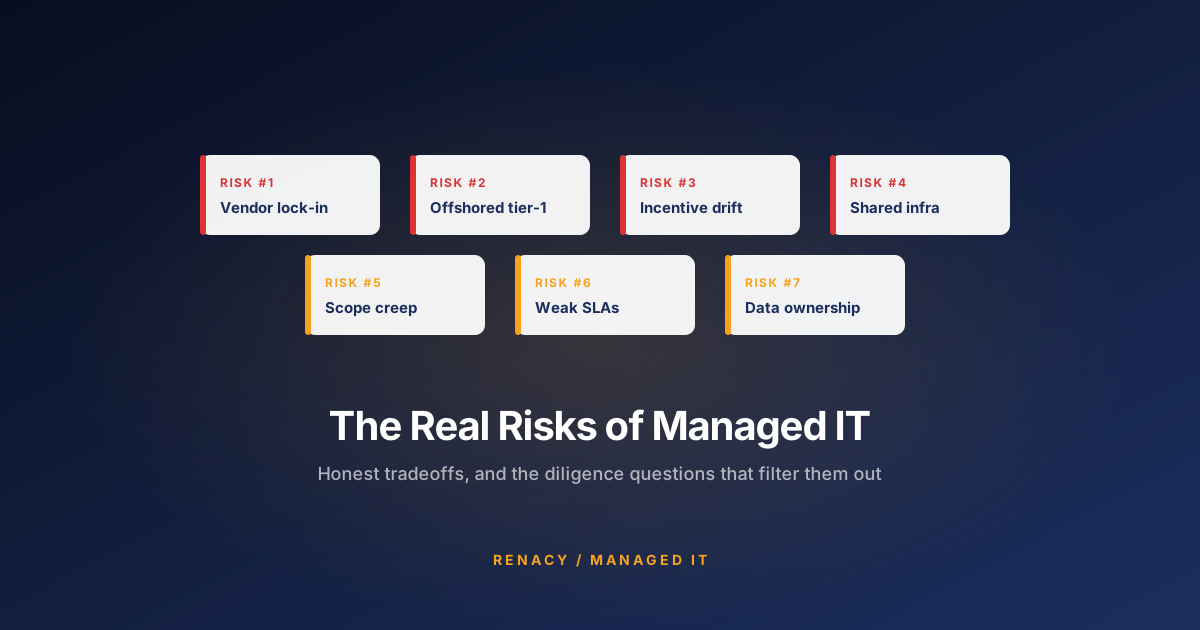
Risk #1: Vendor Lock-In
The dominant risk with any MSP relationship is dependence. Over time, the MSP accumulates knowledge of your environment, holds admin credentials, configures systems in ways that reflect their playbooks rather than yours, and often owns the documentation. Leaving becomes expensive — sometimes intentionally so.
Some lock-in is inevitable and even valuable. You want the MSP to know your environment deeply. What you don't want is lock-in that makes exit prohibitively costly if the relationship breaks down.
Mitigation
Contractually require that all documentation of your environment is delivered to you, not just accessible. Retain admin credentials for all critical systems — the MSP operates through named accounts you can revoke. Require that configurations are documented rather than tribal. Include a termination-for-convenience clause with a defined 60–90 day transition period, and specify that during transition the MSP will hand over runbooks, credentials, and configurations to whoever you choose.
Risk #2: Offshored or Impersonal Tier-1 Support
Many MSPs — especially larger ones — offshore tier-1 helpdesk to reduce cost. This isn't automatically bad, but it's often not disclosed clearly during sales. Clients discover it when a ticket surfaces at 3 AM local time from a technician who doesn't know the environment and is following a generic script.
The result is a support experience that's technically compliant with the SLA — first response within 15 minutes, ticket closed within 4 hours — but doesn't feel like your MSP actually knows you. Complex issues take longer because tier-1 needs to escalate more often, and each escalation adds latency.
Mitigation
Ask directly during evaluation: where is tier-1 physically located, what languages/accents will users encounter, and how much of your account has direct familiarity? Request a call with an actual tier-1 technician who would take your tickets. Include a contractual right to know when the support model changes — some MSPs shift from onshore to offshore mid-contract.
A meaningful indicator of MSP quality is whether specific people are named against your account. A relationship model that assigns a service delivery manager, a technical lead, and named tier-2 engineers is more likely to produce continuity than one where you're assigned to a ticket queue with rotating anonymous responders.
Risk #3: Misaligned Incentives
The pricing model shapes the behavior. Flat-rate managed services aligns incentives well — the MSP is paid to keep things running, so they're motivated to reduce ticket volume, prevent incidents, and automate common issues. Time-and-materials or per-ticket pricing is the opposite — more problems means more revenue.
Even under flat-rate contracts, misalignment can creep in through hardware and software resale. An MSP that earns 20–40% margin on the products they recommend has a bias toward those products, whether or not they're the best technical fit. This is often invisible unless you ask.
Mitigation
Choose flat-rate over hourly billing wherever possible. Ask whether the MSP earns markup on hardware or software recommendations. Prefer providers that pass through pricing at cost or disclose margin transparently. In selection conversations, watch how the MSP talks about "consolidation" — a healthy MSP will help you reduce vendor spend even where it reduces their commission opportunity.
Risk #4: Weak or Aspirational SLAs
Most managed services contracts include SLAs. Some of them mean something. Many are aspirational — targets with no financial consequences for missed performance, or worded so vaguely that any behavior technically complies. "Priority-1 tickets responded to promptly" is not an SLA. "Priority-1 tickets first-response within 15 minutes, resolution within 4 hours, with 5% service credit for each 4-hour block exceeded" is.
The financial consequence is the mechanism that turns an SLA from a promise into an actual commitment. Without it, SLAs are marketing.
Mitigation
Require SLAs with quantified thresholds and financial consequences. Ask for the past 6 months of SLA performance data with existing clients — a confident MSP will share it. Require monthly reporting against every committed metric. If the MSP can't or won't commit to specific numbers, they can't deliver against them.
Risk #5: Shared Infrastructure and Concentration Risk
MSPs often run multi-tenant infrastructure for their clients — shared RMM (remote monitoring and management) tools, shared PSA (professional services automation) systems, sometimes even shared credentials in older setups. A compromise of the MSP's tooling can propagate to all their clients simultaneously.
This isn't hypothetical. Several major MSP-related security incidents in the past few years have followed this pattern — attackers compromise the MSP, then use that access to reach dozens or hundreds of downstream clients through legitimate management tools.
Mitigation
Ask about the MSP's own security posture. Do they have SOC 2 Type II attestation? What's their internal MFA policy? How do they segregate client environments in shared tools? Do they run their own SIEM? A MSP that can't answer these questions with specifics is a weaker security link in your chain than you probably want.
Risk #6: Scope Creep and Contract Drift
A managed services contract starts with a defined scope — devices, users, applications covered. Over time, your environment changes. New applications get added, users grow, hardware gets refreshed. If the contract isn't adjusted, either the MSP absorbs the extra work (and quality degrades) or they push back on requests as out-of-scope (and users get frustrated).
The pattern often plays out slowly. The MSP handles the first few out-of-scope requests as goodwill. Later, they start pushing back. Suddenly the client feels like the MSP is being difficult, when the underlying issue is that the scope was never updated to reflect reality.
Mitigation
Build annual scope reviews into the contract. Include a specific mechanism for adding services (a "change order" or scope amendment). Establish clear thresholds — for example, once user count grows by 20%, the pricing tier adjusts. Regular quarterly business reviews are the mechanism that catches drift before it becomes a dispute.
Risk #7: Data Ownership Ambiguity
Where does your data actually live in an MSP relationship? Some of it is on your devices. Some is in your SaaS. But operational data — ticket history, monitoring data, backup metadata, configuration documentation — often lives in the MSP's systems. If you leave, what happens to that data? Can you export it? In what format? On what timeline?
Similar questions apply during the relationship. If you request all backup restore points from the past year for a compliance audit, can the MSP produce them? On what timeline? At what cost?
Mitigation
Contractually establish that all data related to your account is yours, portable, and exportable in standard formats on reasonable notice. Specify data types explicitly — tickets, monitoring history, backup metadata, configurations, documentation. Include cost provisions (usually free during normal course, defined cost for large historical exports).
The Diligence Checklist
Before signing with an MSP, work through this checklist. Any "no" or evasive answer is a risk you should either mitigate contractually or use to negotiate.
| Question | What a Good Answer Looks Like |
|---|---|
| Where is tier-1 physically located? | Specific geography, willingness to arrange a call with actual staff |
| What's your SOC 2 status? | Type II attestation, willing to share report under NDA |
| Can we retain admin credentials? | Yes, MSP operates through named accounts we can revoke |
| Show me the past 6 months of SLA performance for a similar client | Willing to share (anonymized), numbers align with promises |
| What happens if we terminate? | 60–90 day transition, documented handoff, all data exported |
| Do you earn margin on hardware/software recommendations? | Transparent disclosure, or explicit pass-through pricing |
| How do you segregate clients in shared tools? | Named accounts, MFA-enforced, audit logs per client |
| What's your subprocessor list? | Documented list, notification before changes |
The Contract Language That Matters
Beyond the diligence conversation, specific contract clauses are the difference between a manageable engagement and a bad one:
- SLA definitions with financial consequences — quantified thresholds, service credits for missed targets.
- Data ownership and portability — all client data is client-owned, exportable in standard formats within a defined window.
- Admin credential control — client retains ultimate control; MSP operates through revocable accounts.
- Documentation delivery — runbooks, inventory, and configuration docs delivered to client, not just accessible.
- Termination for convenience — either party can exit with 60–90 day notice, with defined transition obligations.
- Breach notification timeline — specific hours (typically 24–72) for the MSP to notify client of security incidents affecting their environment.
- Subprocessor disclosure and control — client is notified when the MSP changes subprocessors, with right to object.
- Right to audit — client can commission (at their expense) an independent audit of MSP's security posture and SLA performance.
Frequently Asked Questions
What's the biggest risk of using a managed services provider?
Vendor lock-in — specifically, the risk that the MSP owns your documentation, holds your admin credentials, and configures your environment in ways that make switching providers expensive. The mitigation is contractual: from day one, require that all documentation is delivered to you (not just accessible), all admin credentials remain in your control, and configurations are documented rather than tribal knowledge. This makes exit possible without disruption.
How can I tell if an MSP will offshore my helpdesk?
Ask directly. Where is your tier-1 team physically located? What time zones do they cover? Can we speak to someone who would actually take our tickets? A transparent MSP will answer directly. If you get evasive answers, deflection to "partner networks," or vague geography, the answer is almost always that some or all of the support is offshored. This isn't automatically bad, but it should be an informed choice, not a discovery.
How do I make sure the MSP's incentives align with mine?
Flat-rate managed services contracts align incentives well — the MSP is paid to keep things running, so they're motivated to reduce ticket volume and prevent incidents. Time-and-materials or per-ticket pricing misaligns incentives because more problems means more revenue. Also watch for MSPs that resell hardware or software with markup — this creates pressure to recommend products for margin reasons rather than technical fit.
What contract terms should I always require in an MSP agreement?
At minimum: SLA definitions with financial consequences for missed targets, data ownership and portability clauses, admin credential control, documentation delivery, breach notification timelines, subprocessor disclosure, right to audit, and termination-for-convenience with a defined transition period (typically 60–90 days). Also require that all client data can be exported in standard formats within the transition window.
How do I evaluate whether an MSP is actually delivering on the SLA?
Require monthly reporting on all committed metrics — first response time, resolution time, incident count, patch compliance percentage, backup success rate. Compare against the SLA and against prior months. If reporting is inconsistent, missing, or vague ("we're doing great overall"), the MSP is either not measuring or not wanting to share. Quarterly business reviews are where you calibrate on the numbers and identify trends before they become problems.
Related reading: How Managed IT Services Support Growing Businesses →

Renacy is a managed IT support provider serving businesses across New York, New Jersey, Pennsylvania, Connecticut, Massachusetts, Maryland, and Washington DC. Our team specializes in proactive device monitoring, helpdesk support, cloud backup & disaster recovery, and network infrastructure management. Learn more about Renacy →