The IT model that got a business from 10 employees to 40 is almost never the one that gets it from 40 to 150. Growth doesn't just add users — it adds risk, complexity, compliance obligations, and coordination cost that scale non-linearly. The businesses that scale cleanly usually make a specific structural change somewhere in that range: they stop trying to grow their IT function through headcount and switch to a managed services relationship.
The pattern shows up in almost every mid-market business we work with. The founding team hires a first IT person around 15–25 employees. That person does everything — desktop support, network, procurement, vendor management, occasional strategy. It works for a while. Then the business hits 40, 60, 80 employees, and it stops working.
The IT person is now spending most of their time on tickets and can't get to strategy. Coverage gaps appear — no one is available at 6 PM when the CEO needs a laptop reset, no one is watching monitoring at midnight when a backup fails, no one has time to do the compliance work the new customer contract requires. The obvious answer — hire another IT person — is expensive, takes months, and often solves the wrong problem. The real problem is that operating a growing business's IT is a team job, and no single hire can cover the surface area.
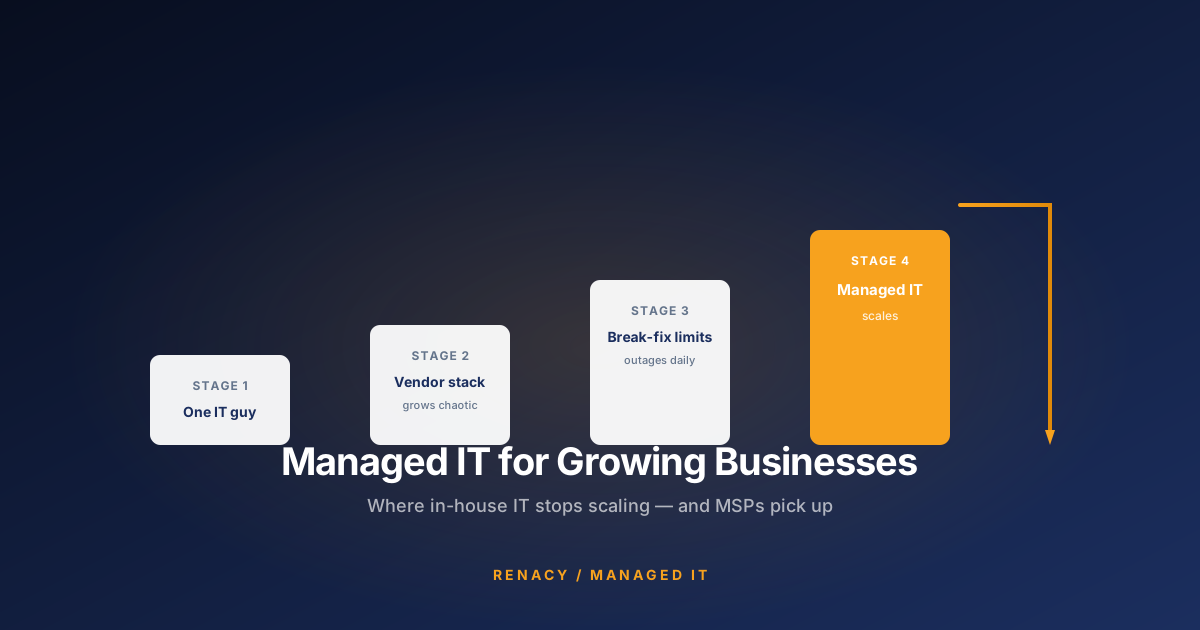
The Stages of IT Maturity
Growing businesses go through predictable stages. Recognizing the current stage is the first step in figuring out what to change.
Stage 1: The Solo Operator (1–20 employees)
One person, usually a founder or an early technical hire, handles everything. IT is informal. Tools are chosen by preference or expedience. Backup happens because someone remembers to run it. This works because the surface area is small and the person doing it knows every part of it.
Stage 2: The Internal IT Hire (20–50 employees)
The business hires its first dedicated IT person. They set up a ticketing system, formalize the tool stack, deploy monitoring, and start writing documentation. This is when IT starts to feel like a function rather than an ad hoc responsibility. The single hire is stretched thin but can hold the operation together.
Stage 3: The Breaking Point (50–100 employees)
The single IT hire can't cover the growing surface area. Vacations, sick days, and after-hours coverage become real problems. Compliance obligations from customers or regulators appear that the internal IT person doesn't have time to handle. Vendor sprawl accelerates. Something is going to have to give.
Stage 4: The Fork (100+ employees)
Two paths open. Path A: hire a second IT person, then a third, then eventually staff up a full internal IT team. Path B: engage a managed services provider that absorbs the operational load, leaving the internal IT lead free to focus on strategy and business partnership. For most businesses in this range, Path B is faster, cheaper, and more resilient.
What Managed IT Actually Delivers to a Growing Business
The pitch for managed services usually gets described as "outsourced IT." That framing is too narrow. The real value is a structural one: an MSP provides team-level coverage of an operation that a single hire (or even two) can't sustain.
24/7 Monitoring and Response
A team can watch the systems around the clock. A single hire can't. When a backup fails at 2 AM, someone sees it and starts the remediation. When a server goes down on a weekend, the response starts within minutes instead of Monday morning. This alone eliminates a category of preventable business disruption.
Depth Where You Need It
A capable MSP has a network specialist, a security specialist, a cloud specialist, and a helpdesk team. Your one internal hire is a generalist. When a hard problem hits, the MSP can escalate to a specialist. The internal hire has to become a specialist mid-crisis.
Predictable Cost, Predictable Coverage
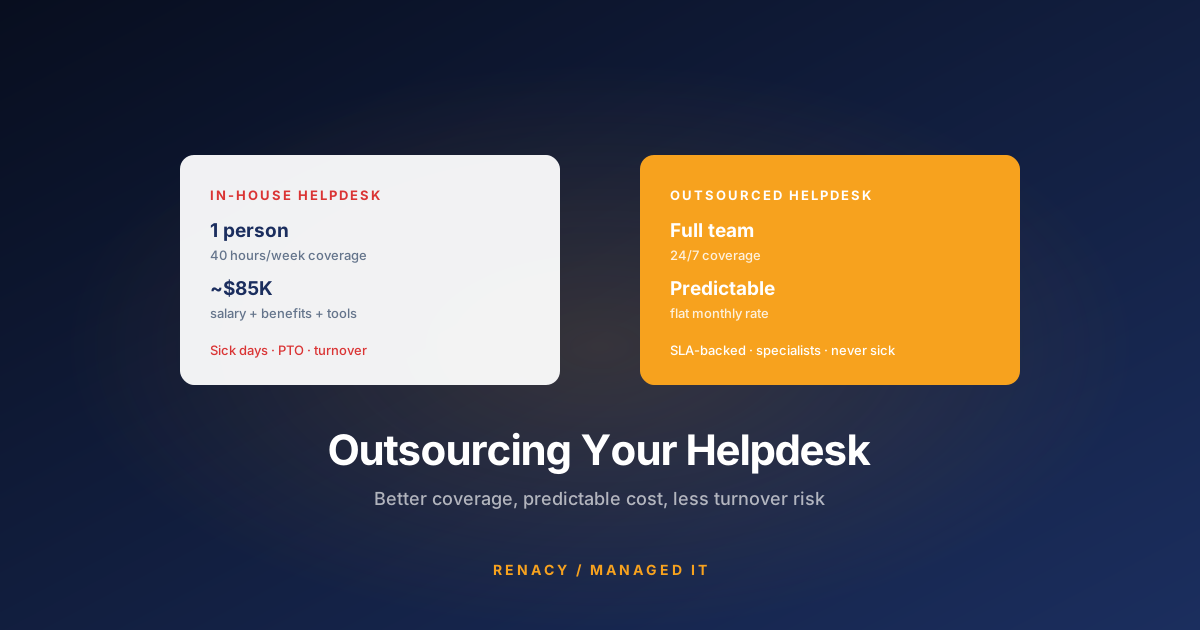
MSP pricing is typically per-user or per-device, flat monthly. There are no billable hours to reconcile, no surprise invoices when a project runs long. Coverage is defined in an SLA. Compare that to internal staffing, where a departure creates immediate coverage gaps and recruiting cycles are 60–120 days at the mid-market level.
Faster Onboarding and Offboarding
Growing businesses hire and fire constantly. Each transition is an IT event. A well-run MSP handles this at scale — new hire gets provisioned across all systems in hours, departing employee gets deprovisioned reliably the same day. Internal IT teams often struggle with this because it's low-priority but high-frequency work.
Ask honestly: what happens to your IT function if your senior IT person is out for a week? If the answer is "we operate at 40% capacity and defer everything possible until they're back," you have a coverage risk that growth will amplify. Managed services solves this by design — the team keeps operating when any single person is unavailable.
Where Managed IT Doesn't Fit
Managed IT isn't universal. There are situations where internal IT staffing is genuinely the right choice:
- Highly specialized environments — businesses running proprietary hardware, custom software stacks, or unusual regulatory environments sometimes need daily hands-on expertise that a general-purpose MSP won't provide efficiently.
- Very tight security models — some regulated environments (defense contracts, certain financial functions) require IT staff cleared to specific standards that an MSP can't provide.
- Companies with mature internal IT (500+ employees) — at this scale, the fixed cost of an internal team amortizes across enough users that the per-user math shifts, and internal control becomes economically justifiable.
The 30–300 employee range is where managed IT is almost always the right structural choice. Below that, the volume doesn't justify it. Above that, hybrids become common.
Managed IT vs. Internal IT: The Real Math
| Dimension | Internal IT (2 hires) | Managed IT (100 users) |
|---|---|---|
| Annual cost | $220K–$280K fully loaded | $180K–$210K flat |
| Coverage | Business hours, gaps at vacation/sick | 24/7 team |
| Specialist access | Whatever the two hires know | Network + security + cloud + helpdesk |
| Turnover risk | High — recruiting 60–120 days | Absorbed by MSP |
| Compliance evidence | Ad hoc; often incomplete | Standard reporting cadence |
| Ramp on new tools | Learn as you go | Playbooks and prior deployments |
| Scalability | Linear — need more hires | Elastic — add users, not headcount |
Signs You've Outgrown Your Current IT Model
The transition point is different for every business, but the signals are consistent. If you see three or more of these in your operation, you're past the natural boundary of a single-hire IT function:
- After-hours issues wait until morning because there's no coverage.
- Vacation weeks feel like operational risk.
- You're paying for shadow IT because departments can't get responses fast enough.
- Onboarding new employees consistently takes more than 48 hours to complete IT-side.
- Customers or auditors have asked for compliance evidence you can't assemble easily.
- Your internal IT lead has stopped doing strategy because tickets take all their time.
- Backup, patching, or monitoring depends on a person remembering rather than a system.
What a Well-Run Managed IT Engagement Looks Like
The engagement model that scales cleanly has a few consistent features:
Named Owners on Both Sides
The MSP assigns a named service delivery manager. The client assigns a named business owner. Both are accountable for the outcome of the relationship. Ticket-driven MSPs without named ownership tend to drift into transactional patterns that don't serve growing businesses.
Structured Quarterly Business Reviews
Every quarter, the client and MSP sit down to review incidents, upcoming projects, business changes, and roadmap. This is the mechanism that keeps the MSP tuned to the business, and vice versa. Skipping QBRs is one of the most common failure modes.
Transparent Reporting
Ticket volume, response times, incident trends, patch compliance, backup status — reported monthly, comparable over time. Managed IT engagements that don't produce this data are impossible to evaluate, and are usually not producing the operational discipline they claim.
Documentation Ownership
The MSP produces and maintains documentation of the client's environment. On day one of an engagement, this is thin. Within six months, it should include a full inventory, network diagram, runbook, and access matrix. The client owns the documentation, not the MSP — critical for continuity if the relationship ever ends.
Frequently Asked Questions
At what company size does managed IT typically make sense?
Managed IT starts making economic sense around 15–25 employees, becomes clearly cheaper than internal IT staffing by 30–50 employees, and remains the dominant model through 200–300 employees. Above that, most businesses run a hybrid — an internal IT lead who directs strategy, and an MSP that operates the day-to-day. Very few businesses under 500 employees are better off with fully internal IT.
Can an MSP really replace an in-house IT hire?
Yes and no. An MSP replaces the operational work — monitoring, patching, helpdesk, backup, incident response, vendor management. It doesn't replace the strategic role of a technology leader who owns roadmap and vendor decisions. Businesses at 30–100 employees typically don't need a full-time technology leader yet, so the MSP model covers everything. Businesses at 100+ often need both.
What's the difference between managed IT and break-fix support?
Managed IT is proactive and priced predictably — the MSP is responsible for keeping things working, and you pay a flat monthly rate. Break-fix is reactive — you pay when something breaks, and the incentive is aligned with billable hours. Managed IT tends to have lower total cost and dramatically lower downtime for businesses beyond about 20 employees; break-fix works below that.
How much do managed IT services cost per user?
Full-service managed IT for growing businesses typically runs $145–$180 per user per month, decreasing as user count grows. This includes 24/7 monitoring, helpdesk, patch management, backup, endpoint protection, and network management. Compared to internal IT staffing (an internal IT hire runs $85K–$140K fully loaded), the per-user math becomes favorable for MSPs around 30–50 employees.
How long does it take to onboard a managed IT provider?
Standard onboarding takes 4–8 weeks. The first two weeks are discovery — inventory of devices, users, applications, and access. The next two to four weeks are deployment — agents installed, backup configured, monitoring instrumented, documentation captured. Full transition is usually complete within 60 days, though some environments with significant legacy infrastructure take longer.
Related reading: Still on Break-Fix IT? Here Are the Signs You've Outgrown It →

Renacy is a managed IT support provider serving businesses across New York, New Jersey, Pennsylvania, Connecticut, Massachusetts, Maryland, and Washington DC. Our team specializes in proactive device monitoring, helpdesk support, cloud backup & disaster recovery, and network infrastructure management. Learn more about Renacy →