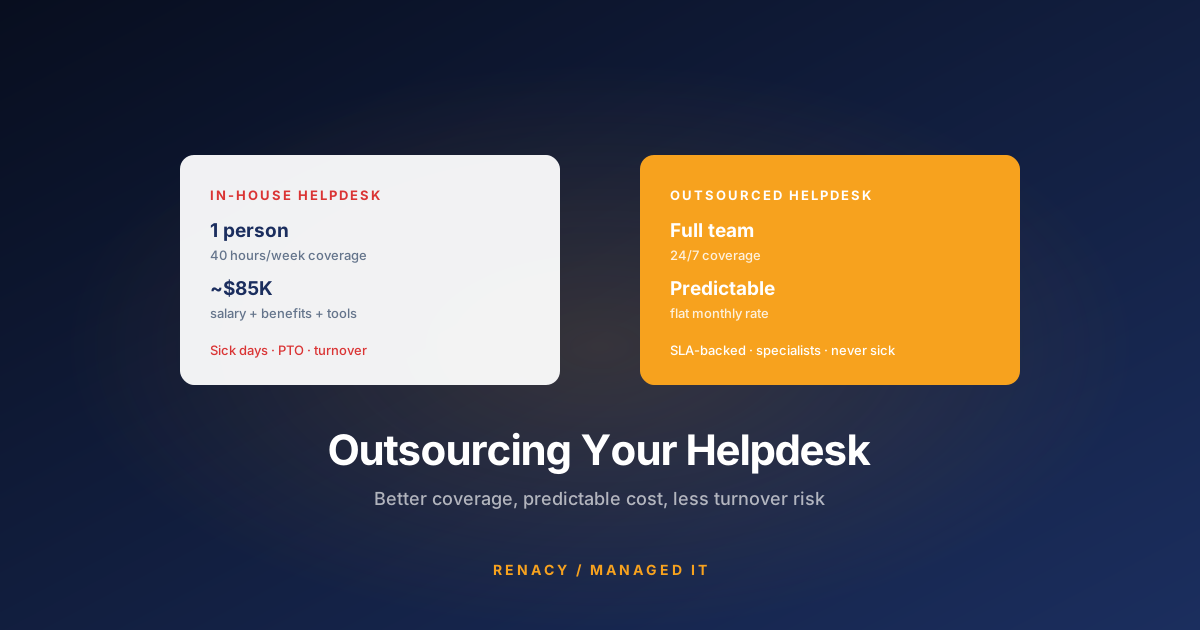
A single internal helpdesk hire looks cheap on the org chart and expensive in practice. One person can't cover 40 hours reliably, let alone 168. The comparison people usually make — internal salary vs. outsourced retainer — misses the actual math. The real trade-off is coverage, escalation depth, and turnover risk, not just cost.
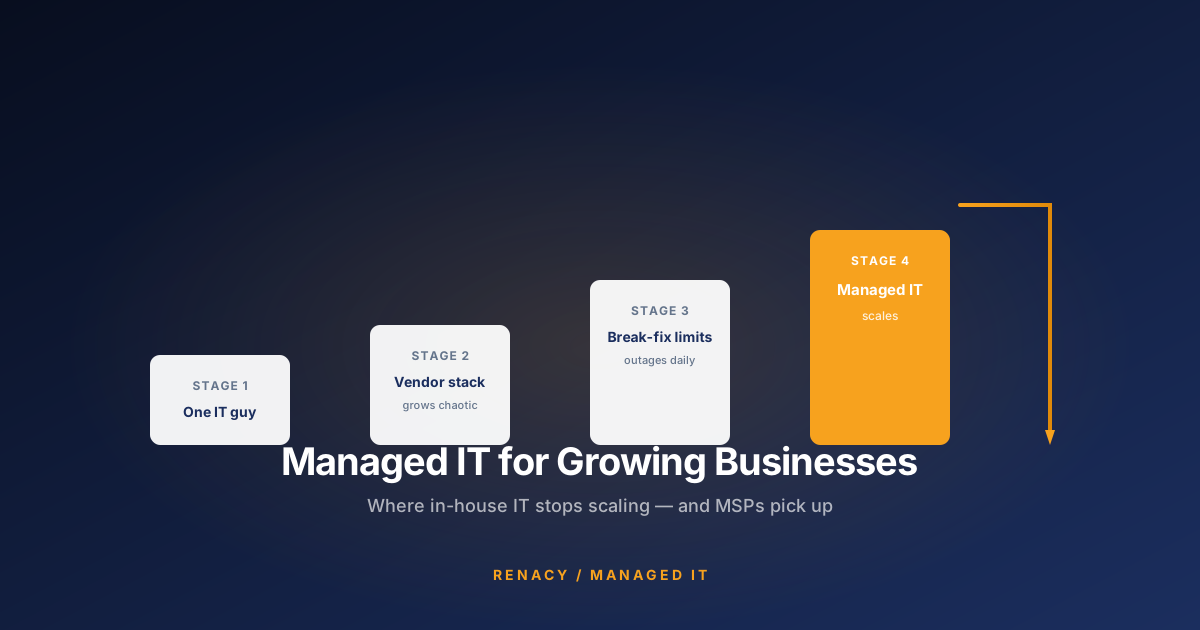
Every growing business hits a moment where the informal "IT is Sarah's job" model breaks. The solution most leaders reach for is to hire a dedicated helpdesk person. It works for a while — until Sarah takes vacation, or the business grows past what one person can handle, or Sarah decides to take the offer from a competitor and leaves you with a two-month recruiting cycle and no coverage.
The alternative most seriously considered is outsourcing the helpdesk function to a managed services provider. The pitch is usually framed as cost savings, but that's the least interesting part of the argument. The compelling benefits are structural.
Benefit #1: Actual Coverage, Not Nominal Coverage
One helpdesk employee is nominally on duty 40 hours per week. Subtract vacation, sick days, training, and administrative work, and the effective ticket-handling time is closer to 30. Subtract the time they're working on longer projects instead of tickets, and it's less. And when they're out entirely — vacation weeks, sick days, medical leave — coverage drops to zero.
An outsourced helpdesk team has real coverage across the schedule. A five-person team means someone is always on duty, someone is always available for escalation, and vacation is a schedule problem for the MSP, not an operational risk for you. For a business where downtime costs are material — which is any business with more than a handful of employees — the difference isn't theoretical.
Benefit #2: Specialist Depth When You Need It
The problems that hit a helpdesk range from "my password isn't working" to "our identity provider is failing to sync to our HRIS." A single hire can handle the first. The second requires specialist knowledge that a generalist can develop over time, but never as fast as a dedicated specialist would.
An outsourced helpdesk has this depth by construction. Tier-1 handles the volume. Tier-2 handles the specific system issues. Tier-3 or engineering handles the escalations that require deep knowledge. Your one internal hire is trying to be all three simultaneously — and doing tier-1 volume while tier-2 tickets pile up on their desk.
Ask your current helpdesk: what happens when a ticket comes in that requires knowledge you don't have? If the answer is "I Google it and figure it out," that's fine for common issues but expensive for hard ones. A structured helpdesk has documented escalation paths and named specialists behind them. If yours doesn't, tier-2 tickets are getting solved by wall-clock time, not by skill.
Benefit #3: Turnover Risk Absorbed by Someone Else
Helpdesk roles have some of the highest turnover in IT. Industry benchmarks put average tenure at 12–18 months. When your one helpdesk person leaves, you have a coverage gap during the recruiting cycle (typically 60–90 days), a ramp-up period once the new hire starts (2–4 months to full productivity), and the cost of the recruiting and onboarding itself.
The math over three years usually looks like this: one departure and one replacement means 30–40% of the coverage window has been at reduced capacity. An outsourced helpdesk absorbs this. When someone on their team leaves, the MSP is responsible for maintaining coverage, and you never see the transition.
Benefit #4: Predictable, Contractual SLAs
"How fast will my helpdesk respond?" is a legitimate question. For an internal team, the honest answer is "it depends what else they're doing." For an outsourced helpdesk, the answer is in the contract: 15-minute first response, 4-hour resolution for standard tickets, escalation within 30 minutes for critical incidents. You can hold the MSP accountable to those numbers with monthly reporting.
The same accountability is hard to establish internally without making the internal team feel like they're being measured against a stopwatch. The SLA structure of an outsourced relationship formalizes expectations in a way that removes ambiguity — and gives you a clean metric to evaluate whether the engagement is working.
Benefit #5: Documentation That Actually Gets Written
Every IT lead knows they should document. Almost none actually do, because documentation is the work that never gets scheduled when tickets are pending. Internal helpdesks tend to accumulate tribal knowledge that dies with the employee when they leave.
Outsourced helpdesks document because they have to. Multiple people need to work the same accounts, escalation requires written runbooks, and audit and QBR reporting requires evidence. The client benefits: after 12 months of outsourced helpdesk, you have runbooks, escalation matrices, and inventory documentation that your internal team never got around to writing.
Benefit #6: Elastic Scale
What happens to your helpdesk when you grow from 60 to 120 employees? An internal team either burns out or needs to double, which means recruiting, hiring, training, and management overhead. An outsourced helpdesk grows by adjusting the contract — the MSP is already operating at scale for other clients, and your incremental volume is absorbed.
The reverse also matters. If you have a reduction in force, an internal helpdesk still costs the same. An outsourced helpdesk scales down with your user count. Elasticity in both directions matters for growing companies whose trajectory isn't always linear.
Benefit #7: Time Back for Your Senior IT People
Perhaps the most underappreciated benefit. In a business with senior IT staff, having them answer tier-1 tickets is a misuse of expensive time. But when the helpdesk is understaffed or non-existent, that's exactly what happens. Password resets, printer issues, and MFA setups pull the senior team away from projects, strategy, and complex work.
Outsourcing tier-1 means your senior staff get their days back. The ROI on this is often the largest single benefit — a $130K senior IT engineer spending 30% of their time on tier-1 tickets is $40K of misallocated capacity. Redirecting that to strategic work is more valuable than the raw cost of outsourcing.
The Cost Comparison
Where the raw numbers matter, they usually favor outsourcing for businesses of 30–200 employees:
| Cost Component | Internal Helpdesk (1 hire) | Outsourced Helpdesk (100-user contract) |
|---|---|---|
| Base compensation | $65K–$95K | Included |
| Benefits (~28%) | $18K–$27K | Included |
| Tools & ticketing platform | $4K–$8K | Included |
| Training & certifications | $3K–$6K | Included |
| Recruiting cost (per replacement) | $12K–$20K | Absorbed by MSP |
| Coverage | 40 hrs/week, minus PTO/sick | Business hours or 24/7 |
| Escalation depth | None (1 person) | Multi-tier by design |
| Effective annual cost | ~$105K–$155K | ~$85K–$130K |
When Internal Helpdesk Is Still the Right Call
Outsourcing isn't universal. There are situations where an internal helpdesk is genuinely better:
- Highly specialized environments where tier-1 tickets require deep knowledge of proprietary systems the MSP will never learn efficiently.
- Extremely regulated industries where all support staff need specific security clearances or certifications.
- Very small teams (under 25 employees) where the volume doesn't justify either model, and the founder or ops lead handles it directly.
- Large enterprises (500+ employees) where the fixed cost of an internal team amortizes across enough tickets that the per-ticket economics shift.
What a Well-Structured Outsourced Helpdesk Engagement Looks Like
Named service manager
A specific person on the MSP side owns the relationship. They know your environment and drive continuous improvement.
Documented SLAs
First response, resolution, and escalation times are contractual — not aspirational. Monthly reporting shows actual performance.
Clean escalation paths
Tier-1, tier-2, and tier-3 escalations are documented. Complex issues route to specialists without your team chasing.
Environment documentation
The MSP builds and maintains runbooks, inventory, and access matrices. You own the documentation.
User feedback loops
Every ticket includes a satisfaction survey. Data flows to monthly reports so patterns get addressed.
Quarterly business reviews
The MSP and client meet quarterly to review ticket trends, upcoming projects, and adjustments to the engagement.
Frequently Asked Questions
How much does an outsourced helpdesk cost compared to hiring internally?
An internal helpdesk hire runs $65K–$95K in base salary, plus 25–30% in benefits, plus $8K–$15K in tools and training — roughly $95K–$140K fully loaded, for 40 hours/week of coverage. An outsourced helpdesk for the same headcount typically runs $75K–$110K/year, but delivers business-hours or 24/7 coverage without gaps for sick days, PTO, or turnover.
Won't an outsourced helpdesk be less responsive than internal staff?
For most ticket categories, a well-run outsourced helpdesk is more responsive. Response SLAs are contracted — typically 15 minutes to first response and 4 hours to resolution for standard tickets. Internal helpdesk response times are determined by whoever is available and what else they're doing. Where outsourcing can fall short is deep familiarity with unique environments — which is why documentation and QBRs matter.
What can and can't an outsourced helpdesk handle?
Tier-1 tickets — password resets, printer issues, software installs, MFA setup, account provisioning, basic troubleshooting — are handled by the outsourced team completely. Tier-2 tickets involving specific business applications benefit from documented runbooks and are usually handled as well. Complex vendor-specific issues (specialized industry software, custom-built internal tools) may require escalation to internal owners or the vendor directly. A capable MSP is transparent about what falls where.
Is my data secure when I outsource helpdesk?
With a properly structured engagement, yes. The MSP should have SOC 2 Type II attestation or equivalent, sign a Business Associate Agreement if you're in healthcare, and access your systems through named accounts with MFA and audit logging. What creates risk isn't outsourcing itself — it's outsourcing without contractual clarity on data handling, access controls, and breach notification.
Can we outsource just tier-1 and keep tier-2/3 internal?
Yes, and this is a common hybrid model for mid-market businesses (100–300 employees). The MSP handles tier-1 volume, freeing internal senior IT staff to focus on projects, strategy, and complex issues. Success depends on clean escalation paths — the internal team needs to trust that tier-1 tickets are actually being solved and only well-scoped escalations reach them.
Related reading: How Managed IT Services Support Growing Businesses →

Renacy is a managed IT support provider serving businesses across New York, New Jersey, Pennsylvania, Connecticut, Massachusetts, Maryland, and Washington DC. Our team specializes in proactive device monitoring, helpdesk support, cloud backup & disaster recovery, and network infrastructure management. Learn more about Renacy →