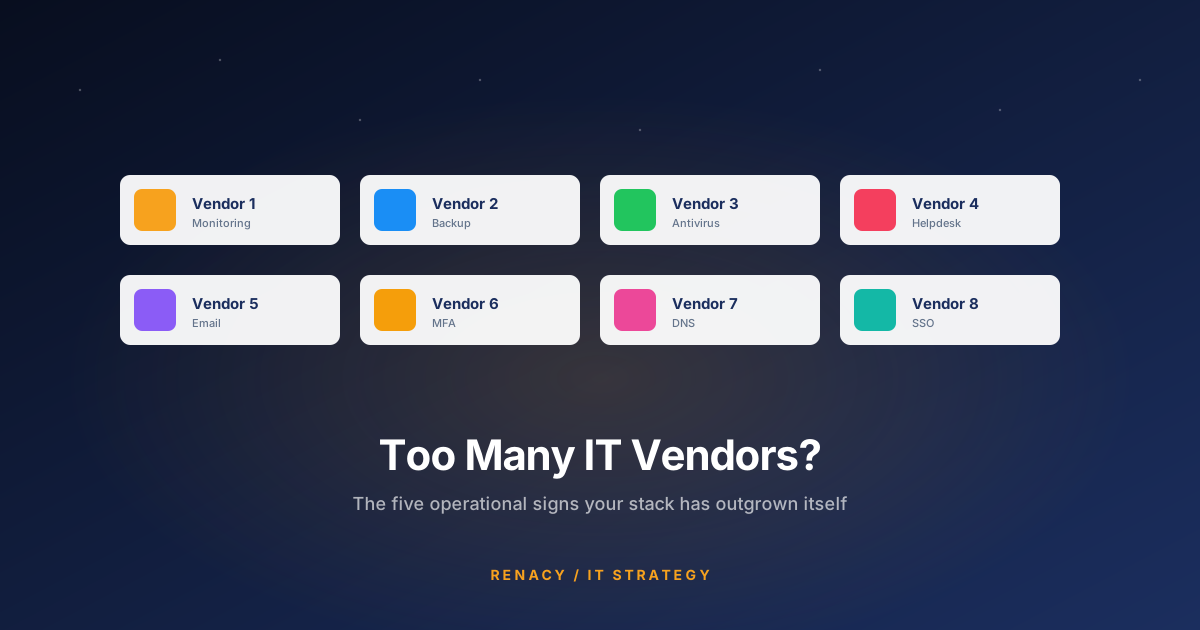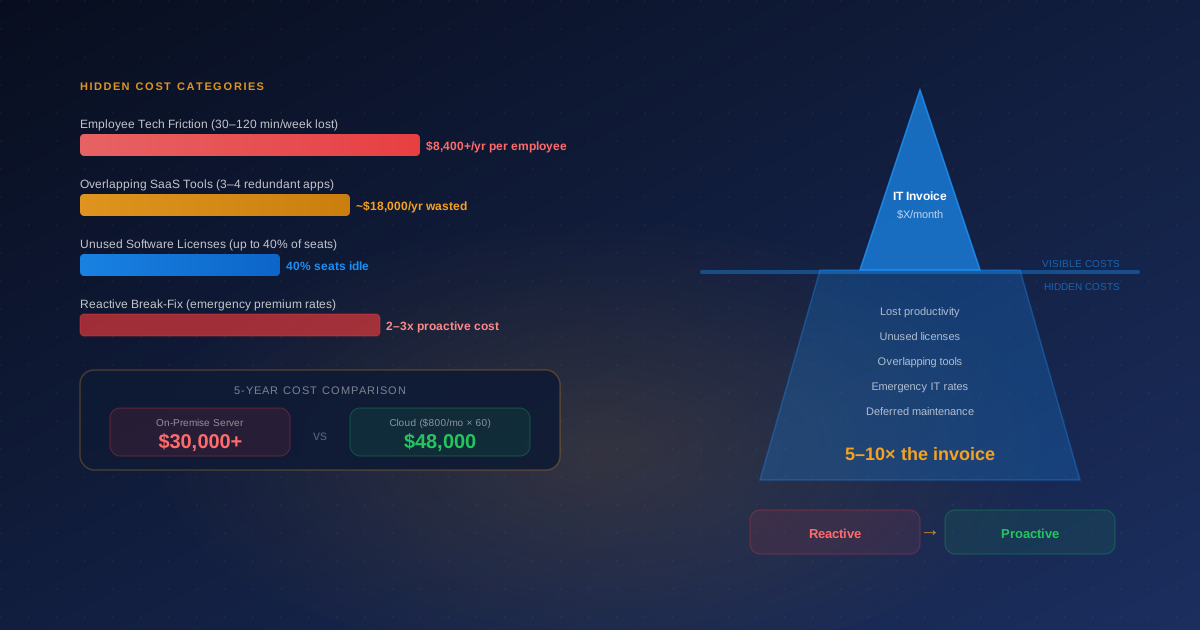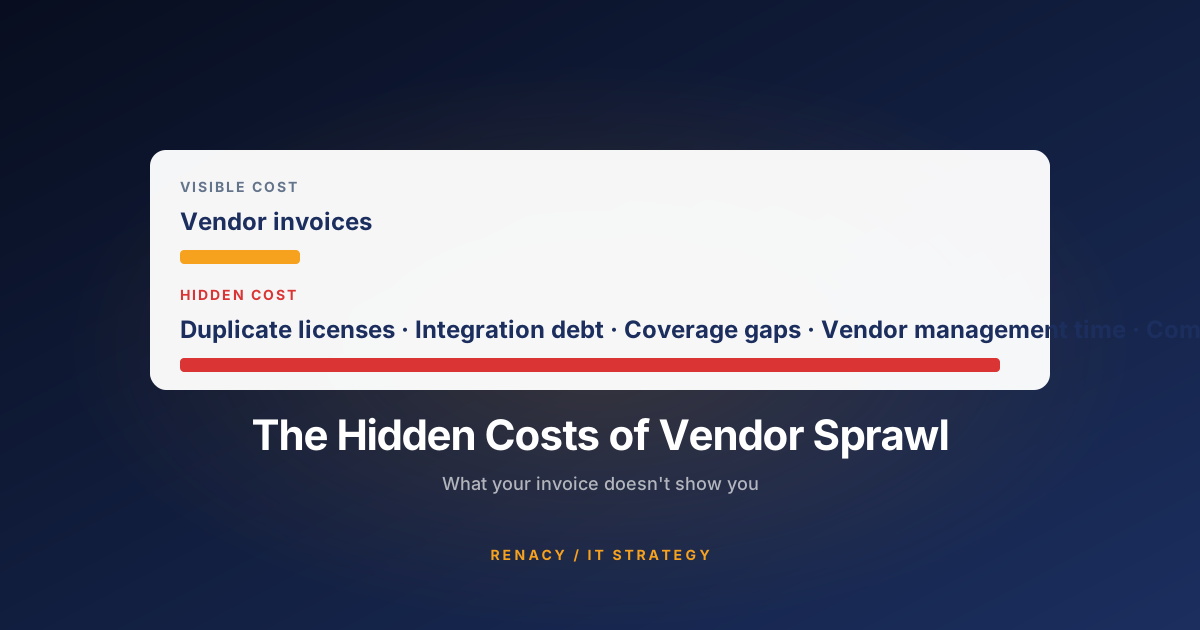
The invoice is the smallest part of what a vendor costs you. It's the part that shows up on the financial statement, but the actual total — the license, the integration, the compliance work, the coordination overhead, the coverage gap it leaves — is usually 40–80% higher. Vendor sprawl is what happens when this hidden cost compounds across ten vendors instead of three.
The pattern isn't about any one vendor being bad. It's about the aggregate math. Each vendor adds a fixed overhead that scales with the number of vendors — not with your business size. Five vendors that each require a security review is more than 5× the work of one vendor, because now you also have to coordinate the reviews, normalize the outputs, and reconcile the overlaps.
Most finance teams underestimate this because vendor management is distributed across departments. IT owns some vendors, security owns others, department managers own department-specific tools, and everyone signs their own contracts on their own timelines. The line-item cost is visible. The coordination cost, the duplication cost, and the coverage-gap cost never make it into the same spreadsheet.
Cost #1: Duplicate Licensing You Didn't Know You Had
The most measurable hidden cost is licenses you're paying for that overlap with other licenses you're also paying for. This is different from unused seats (which is a separate problem). Duplicate licensing is when two vendors provide overlapping capability, and both are billed regardless.
The most common examples: an MSP that includes endpoint protection AND a standalone endpoint security vendor. A collaboration suite that includes storage AND a separate storage service. A security platform that includes DNS filtering AND a dedicated DNS filtering vendor. An identity provider that includes MFA AND a legacy MFA tool that nobody turned off.
The functional test is simple: if you removed vendor A tomorrow, would anything actually break — or would the capability be picked up by vendor B automatically? If the answer is "nothing breaks," you have duplication.
Cost #2: Integration Debt
Every vendor needs to be integrated with the rest of your stack — SSO, provisioning, logging, alerting, compliance reporting. In a healthy stack, this integration surface is standard and tested. In a sprawled stack, it's a mix of vendor connectors, custom scripts, and manual processes that all have to be maintained by someone.
The debt shows up when the integration breaks. A vendor updates their API and the sync stops working. An identity attribute changes and provisioning to one vendor silently stops working while another vendor keeps functioning. A log format shifts and the SIEM ingestion breaks. The team fixes it — but the fix is per-vendor, per-integration, forever, and the maintenance cost scales linearly with vendor count.
For a mid-sized business, the total cost of a typical SaaS vendor is roughly 1.6× the license invoice when you fully load onboarding, integration, security review, contract renewal cycles, and ongoing management time. If your visible IT spend is $500,000, the actual burden is closer to $800,000. Consolidation doesn't just save the license — it saves the 60% multiplier applied to each retired vendor.
Cost #3: Vendor Management Time
Every vendor requires human attention. Someone runs the initial security review. Someone tracks the contract renewal. Someone attends the quarterly business review. Someone handles the annual pricing conversation. Someone updates the internal documentation when the vendor changes their portal. Someone reconciles the invoice against the actual usage.
For most mid-sized businesses, the vendor management burden per vendor averages 15–40 hours per year — small enough to ignore per-vendor, but multiplied by 30 vendors becomes 450–1,200 hours annually. That's a quarter to half of a full-time IT employee's capacity spent on vendor administration instead of anything strategic.
Cost #4: Compliance and Audit Overhead
Every regulated business (or every business selling into regulated ones) faces a compliance overhead per vendor. Each vendor with access to production data needs a signed data processing agreement, a security assessment, a documented risk tier, and evidence for annual audits. If you're SOC 2 audited, HIPAA-covered, GDPR-subject, or CCPA-subject, each of these adds review time.
The overhead is roughly the same whether the vendor is critical or peripheral — the review paperwork doesn't know the difference. This means peripheral vendors, which sprawl attracts, disproportionately load your compliance function. Consolidating 10 peripheral vendors into 2 consolidated relationships doesn't save 80% of the compliance work — it typically saves 60%, but that's still material.
Cost #5: Coverage Gaps Nobody Detected
Sprawl doesn't just create duplication — it also creates gaps. When multiple vendors each handle part of a capability, and the boundaries aren't explicit, the assumption is that the other vendors cover what any given one doesn't. Sometimes they do. Sometimes they don't, and nobody notices until something goes wrong.
Common patterns: monitoring is deployed by one vendor but not to the servers another vendor manages. Backup is configured for the file server but not the newly-added application database. MFA is enforced on the primary directory but not on the shadow-IT directory a department set up. Every gap is invisible until an incident makes it visible — and then the fingerprints of "we thought the other vendor had that" are all over the postmortem.
Cost #6: Data Portability Friction
When you finally decide to consolidate, the cost of leaving a vendor is often surprising. Data export formats are proprietary. Integrations that took months to build have to be untangled. Historical records that a compliance framework requires you to retain may have to migrate. The vendor lock-in wasn't obvious when the relationship started — it emerged as configuration accumulated.
The cost isn't always financial. Sometimes the export is technically simple but operationally disruptive: staff have to be retrained, historical dashboards have to be rebuilt, integrations have to be reworked. Sprawl amplifies this because each vendor has its own version of this friction, and consolidating requires paying it multiple times.
Cost #7: Onboarding Friction for New Hires
New employees need access to whatever vendors they need to do their job. In a consolidated stack, this is one provisioning action against SSO, which propagates to everything. In a sprawled stack, it's a checklist of vendors, each with its own account creation, license assignment, and access review process.
The direct time cost matters, but the more expensive part is what happens when steps get missed. A new hire who doesn't have access to one of 15 tools might not discover it for weeks, or might work around it by using a former employee's credentials still active in the system. The provisioning problem and the offboarding problem are two sides of the same sprawl coin.
The Real TCO of a Sprawled Stack
Put the pieces together and the total cost of a sprawled stack usually looks like this, for a typical 100-employee business with 15–20 vendors:
| Cost Category | Sprawled Stack (~18 vendors) | Consolidated Stack (~5 vendors) |
|---|---|---|
| Direct license spend | $180,000/yr | $135,000/yr |
| Duplicate/unused licensing | $22,000/yr | $3,000/yr |
| Vendor management time (@$75/hr) | $48,000/yr | $12,000/yr |
| Integration maintenance | $18,000/yr | $4,000/yr |
| Compliance/audit overhead | $25,000/yr | $9,000/yr |
| Incident cost from coverage gaps | $30,000/yr (avg) | $8,000/yr |
| True annual TCO | ~$323,000/yr | ~$171,000/yr |
The visible spend difference between the two is only $45,000. The invisible difference is more than triple that. Every additional vendor you can consolidate is a compounding return, not just a line-item saving.
How to Actually See the Cost
Because most of the cost of sprawl is hidden across departments and cost centers, the first job is to make it visible. The steps that work:
Build a Vendor Ledger, Not a Line-Item Budget
Create a single view that includes every IT-related vendor, with columns for license spend, category (endpoint / identity / network / etc.), owner, contract terms, security review status, and renewal date. Even the act of assembling this ledger surfaces vendors that no one was tracking.
Attribute the Hidden Costs Explicitly
Add columns for estimated vendor management time, integration debt, and compliance overhead. Even rough estimates matter — the goal is to shift the discussion from "what does the license cost?" to "what does the vendor cost in total?"
Compare Against a Reference Architecture
For most businesses of 50–500 employees, a consolidated architecture is 4–7 core IT vendors. If your ledger has 15+, the delta between where you are and where you could be is the sprawl tax.
Sequence Consolidation by ROI, Not by Contract Date
The vendors most worth retiring first are the ones with the largest hidden cost relative to their visible cost — high-overlap tools, high-review vendors, high-integration vendors. Contract dates are constraints on execution, but the order should be driven by the total cost math.
Frequently Asked Questions
What percentage of IT spend is typically hidden in vendor sprawl?
For mid-sized businesses (50–500 employees), hidden costs of vendor sprawl typically add 25–45% to the visible IT budget. Duplicate licensing accounts for 8–12%, vendor management overhead for 5–8%, integration and compliance work for 6–10%, and coverage gaps that surface as productivity loss or incident duration add the rest.
How do I calculate the true cost of an IT vendor?
Sum the license invoice, the internal time spent managing the relationship (onboarding, security review, contract renewal, monthly meetings), the integration cost with your other systems, the compliance evidence work, and the cost of the coverage overlap or gap it creates. For most vendors this is 1.4–1.8× the invoice price. Sprawl exists when the total is even higher because of duplication.
Isn't vendor diversification good for resilience?
Real diversification is intentional — a specific backup vendor for a specific data class, or dual carriers for critical connectivity. Sprawl isn't diversification, it's accumulation without design. Diversification concentrates risk-relevant redundancy where it matters; sprawl scatters it randomly and creates coordination cost without corresponding resilience.
How quickly can consolidation return the investment?
Direct license savings usually show up within the first quarter. Full TCO recovery, including reduced management time and integration debt, typically completes within 6–12 months. The soft benefits — clearer accountability during incidents, faster onboarding, cleaner audit evidence — compound over multiple years.
What should I never consolidate?
Categories where the same vendor would create a genuine conflict of interest — for example, the auditor and the audited system shouldn't be the same vendor. Also, any regulated function where a specific certification (HIPAA, SOC 2, HITRUST) requires a vendor with that certification. Everything else defaults to consolidation unless there's a documented reason to keep it separate.
Related reading: 5 Signs Your Business Has Too Many IT Vendors →

Renacy is a managed IT support provider serving businesses across New York, New Jersey, Pennsylvania, Connecticut, Massachusetts, Maryland, and Washington DC. Our team specializes in proactive device monitoring, helpdesk support, cloud backup & disaster recovery, and network infrastructure management. Learn more about Renacy →