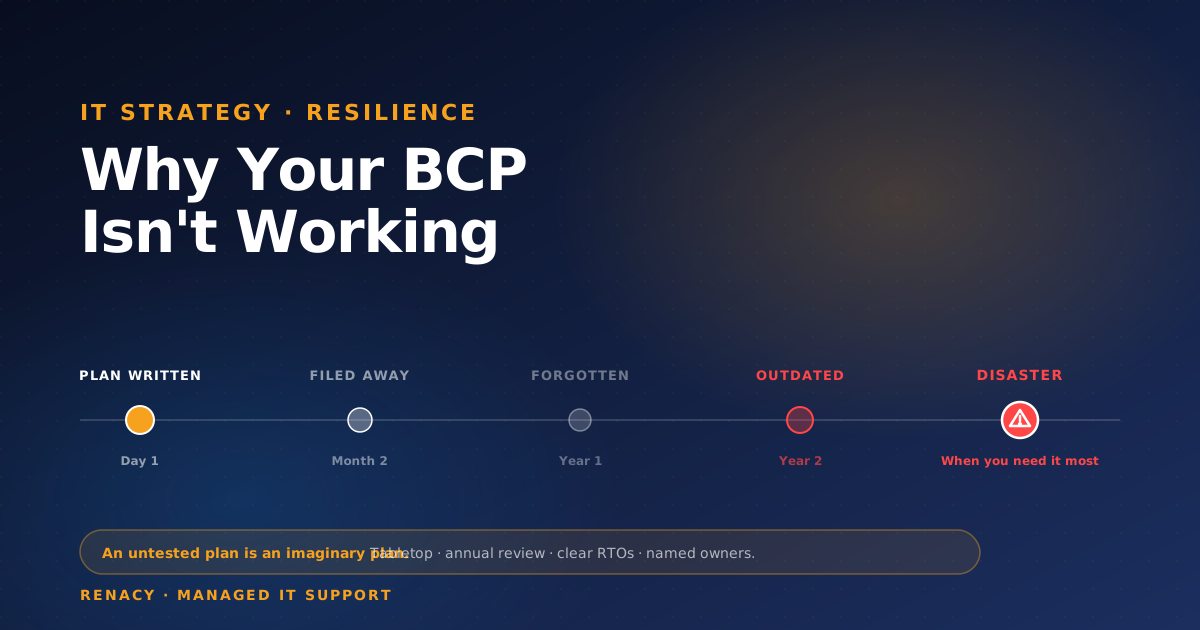
Most business continuity plans aren't broken because they were written badly. They're broken because they were written once, filed away, and never touched again — and by the time an incident actually happens, half the contact information is wrong, the recovery assumptions are stale, and nobody who responds to the incident has read the document.
The dirty secret of business continuity is that the plan itself is the easy part. Almost any operational consultant or IT provider can produce a credible BCP document in a few weeks. The hard part is keeping it useful — and connecting the plan on paper to the people, systems, and decisions involved in actually responding to a real incident.
If your BCP last got updated more than 18 months ago, has never been tested with an exercise, or lives only as a PDF in a SharePoint folder, the honest assessment is that you don't really have one. You have an artifact. Here's why that happens — and what a working BCP actually looks like.
The Most Common Reasons BCPs Fail
Across industries, the same handful of structural problems show up again and again. Knowing the failure modes makes it easier to spot them in your own plan.
It was written for a compliance audit, not for an actual incident
The plan satisfies a checklist somewhere — a vendor security questionnaire, a SOC 2 audit, a regulatory requirement — and was never designed to be operationally useful. It's long, comprehensive, and impossible to act on at 2 AM during a real disruption.
It's never been tested
The plan looks reasonable on paper. Whether it actually works is unknown because no one has ever walked through it. The first "test" is the real incident, which is the worst possible time to discover that step 4 doesn't exist anymore.
The contact information is out of date
The plan references people who left the company two years ago, vendors that were replaced, and phone numbers nobody answers. Contact data goes stale faster than any other component, and most plans have no maintenance discipline.
RTO and RPO targets are aspirational, not achievable
The plan declares that critical systems will be back within 4 hours. The actual backup configuration, hardware, and team capacity make 4 hours impossible. The targets and the operational reality have never been reconciled — usually because nobody pressure-tested the assumptions.
It assumes systems that don't exist anymore
The plan describes a recovery process for an on-premise email server that was migrated to Microsoft 365 three years ago. Or it references a backup vendor that's been replaced. Without ongoing review, the plan and the environment drift apart silently.
Nobody owns it
It's "IT's job" or "the COO's job" or "everybody's job" — which means it's nobody's job. Without a named owner with explicit authority and an annual update cadence, BCPs decay by default.
What a Working BCP Actually Looks Like
A useful BCP is shorter than most plans, more specific than most plans, and updated more often than most plans. It answers concrete questions: who decides, who acts, what gets prioritized, and how the business continues operating while restoration happens.
Tiered System Inventory
Every business system classified by criticality (mission-critical, important, supporting) with clear RTO and RPO for each tier. Not every system needs four-hour recovery — and pretending it does makes the plan unaffordable and unactionable.
Defined Decision Authority
Who has authority to declare a major incident, engage external IR support, communicate with customers, and approve unbudgeted spend during a response? Named roles, named backups, escalation paths.
Manual Fallback Procedures
How does the business operate when systems are unavailable? Specific written procedures for taking orders, dispatching, billing, communicating with customers — short enough that staff can actually follow them under stress.
Maintained Contact Tree
Internal staff, key vendors, insurance broker, IR firm, legal counsel, regulators where applicable. Updated quarterly with verification that the contact methods still work.
Communication Templates
Pre-drafted messages for customers, employees, and (if relevant) regulators or media. Drafted once, reviewed by legal and PR, ready to adapt and send when minutes matter.
Annual Tabletop Exercise
A guided walkthrough where leadership responds to a realistic scenario in real time. Findings feed directly into the next plan revision. Without this, the plan never gets stress-tested in low-stakes conditions.
The Tabletop Exercise: Where Plans Go to Get Real
If you do nothing else with your BCP this year, run a tabletop exercise. It is the single most effective way to find the gaps that always exist between a written plan and an executable one — and it costs almost nothing relative to the value.
A tabletop is structured like this: leadership and IT gather for two to three hours. A facilitator presents a scenario (a ransomware attack, a major cloud outage, a fire at the primary office) and walks the group through it in real time. At each decision point, the participants describe what they would actually do — and the facilitator captures the gaps between what the plan says and what people actually know how to do.
Across hundreds of tabletop exercises, the same patterns surface: nobody knows the current backup retention policy, the "disaster recovery contact list" has departed staff on it, the documented RTO is unachievable with current infrastructure, and decision authority is unclear in the first 30 minutes of an incident. These are exactly the gaps that catastrophically slow real incident response.
The Maintenance Discipline That Actually Keeps a Plan Alive
The difference between a BCP that works and one that decays is almost entirely about maintenance cadence. Plans that are reviewed on a regular schedule stay useful. Plans that are reviewed when someone remembers to do it become artifacts.
| Activity | Cadence | Who Owns It |
|---|---|---|
| Contact list verification | Quarterly | BCP owner / HR partnership |
| System inventory & criticality review | Semi-annually | BCP owner + IT |
| RTO / RPO validation | Annually + after major changes | IT + business unit leads |
| Tabletop exercise | Annually (minimum) | BCP owner + executive sponsor |
| Backup restoration test | Quarterly | IT or managed IT provider |
| Full plan refresh | Annually + after major incidents | BCP owner + cross-functional review |
Connecting the BCP to Real Operations
The deeper insight is that business continuity isn't a document. It's the muscle memory of an organization to keep functioning under stress — and that muscle memory only develops through deliberate practice. The document is useful only insofar as it captures the practice and makes it transferable.
That reframing changes the success criteria. A "good" BCP isn't one that's comprehensive on paper. It's one that the people who would respond to an incident have read, practiced, and can locate quickly when they need it. Most BCPs are written for an auditor. The good ones are written for a colleague at 3 AM during an outage.
Frequently Asked Questions
What's the difference between a business continuity plan and a disaster recovery plan?
A disaster recovery plan focuses narrowly on restoring IT systems after an outage — backups, restoration order, technical recovery procedures. A business continuity plan is broader: it covers how the business operates during disruption, including manual workarounds, communication, vendor coordination, and decision authority. Most organizations need both, but they answer different questions.
How often should we test our BCP?
At minimum, annually with a tabletop exercise — a guided walkthrough where leadership and IT respond to a simulated incident in real time. Higher-risk industries (financial services, healthcare) often run additional functional tests of specific systems quarterly. The point is not to pass the test but to discover the gaps that always exist between the plan as written and the plan as it would actually be executed.
What is RTO vs RPO?
RTO (Recovery Time Objective) is how quickly a system must be back online after a disruption. RPO (Recovery Point Objective) is how much data loss is acceptable, measured in time — for example, an RPO of 1 hour means backups must be at most 1 hour old. Defining these for each critical system is the foundation of any meaningful BCP.
Who should own the BCP?
A named individual — typically a senior operations leader, COO, or designated business continuity officer — with explicit authority to update the plan and convene tabletop exercises. IT supports the technical components, but a BCP that lives only inside IT consistently fails because the most important decisions during an incident are not technical.
Can a managed IT provider help build or maintain our BCP?
Yes, particularly for the technical components: documenting recovery procedures, defining RTO/RPO targets aligned to business priorities, testing backups, and facilitating tabletop exercises. The business-side decisions — who has authority during an incident, how customers are communicated to, what manual procedures look like — must come from leadership, but a good IT provider can structure the conversations and document the outcomes.

Renacy is a managed IT support provider serving businesses across New York, New Jersey, Pennsylvania, Connecticut, Massachusetts, Maryland, and Washington DC. Our team specializes in proactive device monitoring, helpdesk support, cloud backup & disaster recovery, and network infrastructure management. Learn more about Renacy →


