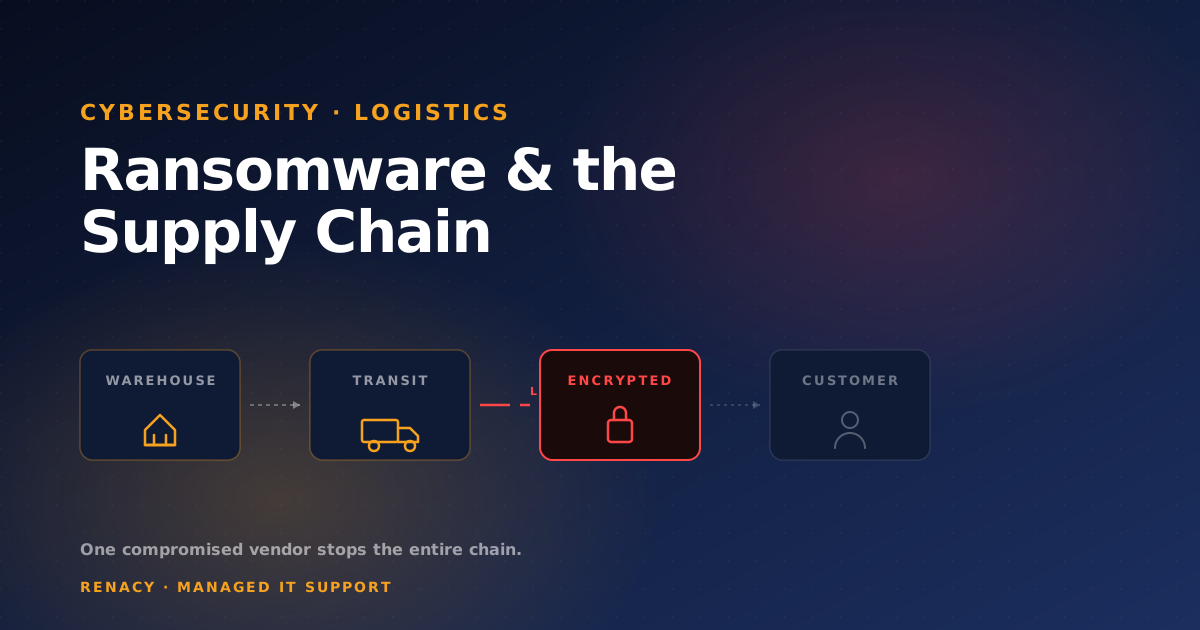
When a logistics provider goes down, the impact doesn't stop with that company. Trucks idle, deliveries miss windows, and dozens of customers further down the chain absorb the consequences. Ransomware operators know this — and they've learned to charge a premium for it.
Logistics, freight, warehousing, and 3PL operations have moved to the top of the ransomware target list. The reason isn't hard to understand: time-sensitive operations create leverage. An attacker who locks up a manufacturer's ERP knows the victim has a few days to figure out a workaround. An attacker who locks up a logistics hub knows the victim has hours before customer contracts trigger penalty clauses.
That economic pressure is reshaping the threat landscape for transportation and supply chain businesses. Attackers price their demands to match the cost of downtime, and they target operations that they've already studied — the ones where shutting down for 24 hours genuinely cripples the business.
Why Supply Chain Operations Are a Prime Target
Three structural realities make logistics operations attractive to ransomware groups, and understanding them is the starting point for any meaningful defense.
Time Is Money — Literally
A frozen warehouse management system means trucks aren't loaded, drivers aren't routed, and orders aren't picked. The cost of downtime per hour is unusually easy to calculate, which makes the ransom math equally easy for attackers.
Interconnected Systems
Logistics operations integrate with ERP, customer portals, EDI feeds, scanner devices, and routing software. A single compromised system can spread quickly to partner networks — and a single compromised vendor can spread into yours.
Aging Operational Technology
Warehouse scanners, conveyor controllers, and dock management systems often run on older operating systems that can't be patched easily. This OT footprint becomes the weak link that lets attackers move laterally from office IT into production systems.
Distributed Workforce
Drivers, dispatchers, and warehouse staff use shared devices, kiosks, and mobile scanners. The traditional security perimeter doesn't exist — and identity-based controls become the primary defense, often without the supporting infrastructure to enforce them.
How a Supply Chain Compromise Actually Unfolds
The popular image of a ransomware attack is a sudden encryption event — files locked, a ransom note on screen. The reality is slower and more deliberate. Most logistics ransomware incidents follow a predictable pattern:
1. Initial Access (Days 1–3)
An attacker gains access through phishing, exposed remote access (RDP without MFA is still common), or a compromised third-party vendor with network connectivity. They're not interested in encryption yet — they're mapping the environment.
2. Reconnaissance and Lateral Movement (Days 3–14)
The attacker quietly explores the network, identifies the most critical systems, locates backups, and looks for ways to disable recovery. In logistics environments, this means studying the warehouse management system, the ERP, and any operational technology that controls physical movement.
3. Exfiltration (Days 7–21)
Modern ransomware groups steal data before encrypting it. This sets up a double-extortion scenario: even if backups exist, the attacker threatens to leak customer data, contracts, or operational records publicly. For logistics companies, that data often includes customer shipment patterns, pricing, and contract terms — all valuable to competitors.
4. Detonation
Encryption typically happens at night or over a weekend. Backups are encrypted or deleted first. By the time staff arrive Monday morning, every system needed to operate is unavailable, and a ransom demand is waiting.
The hardest part of a ransomware response in logistics isn't paying or not paying — it's operating manually while systems are restored. Companies that haven't practiced manual fallback procedures discover, mid-crisis, that they don't actually know how to dispatch trucks or reconcile shipments without their software.
The Vendor Risk Multiplier
The most underestimated risk in supply chain security is the third-party vendor with network access. A small bookkeeping firm, a freight broker integration, or an EDI vendor with a credentialed VPN connection becomes the attack path that bypasses every security control you've invested in directly.
Most logistics companies have dozens of these connections. Few have catalogued them. Even fewer have asked their vendors hard questions about their security posture, response capabilities, or breach notification practices. The result: a security perimeter that's only as strong as the weakest organization with a connection into your network.
| Vendor Type | Typical Risk | What to Verify |
|---|---|---|
| Freight brokers / TMS partners | API and EDI access into routing systems | API key rotation, IP allowlisting, logging |
| Maintenance contractors (HVAC, conveyor) | Remote access into OT systems | Just-in-time access, MFA, isolated VLAN |
| Customer portals / EDI providers | Persistent connectivity to internal systems | Network segmentation, zero-trust posture |
| Accounting and payroll vendors | Access to sensitive financial data | SOC 2 documentation, encryption at rest |
| Managed service providers | Privileged access across the environment | EDR, MFA, audit logs, incident playbook |
Hardening the Operations That Attackers Target
The good news is that ransomware preparation isn't mysterious. The controls that defend a logistics environment are well-understood — they just need to be deployed with the operational realities of warehouses, dispatch centers, and distributed staff in mind.
Segment IT From Operational Technology
The single most impactful control is network segmentation. Warehouse management systems, scanners, and OT controllers should live on a separate VLAN from office IT, with strict firewall rules between the two. When phishing compromises a dispatcher's laptop, the blast radius stops at office systems — production keeps running.
Multi-Factor Authentication on Everything Remote
Every remote access path — VPN, RDP, cloud admin portals, vendor connections — must require MFA. Compromised passwords are the most common ransomware entry point, and MFA is the single control that breaks that chain. There are no exceptions worth making.
Backups That Survive the Attacker
Modern ransomware groups specifically hunt and delete backups before detonating. Backups need to be immutable (write-once, can't be modified after creation), offline or air-gapped from production credentials, and tested regularly. A backup that has never been restored is not a backup — it's a hope.
Endpoint Detection & Response on Every Device
Traditional antivirus catches yesterday's threats. EDR detects the behaviors of an attacker actively moving through your environment — credential dumping, lateral movement, suspicious privilege escalation — and gives your team a chance to respond before encryption begins.
An Actual Incident Response Plan
Not a binder, not a Word document. A playbook with named owners for each role, current contact information for legal, your insurer, and an external IR firm, and clear decisions made in advance about when to engage law enforcement. Tested at least annually with a tabletop exercise that includes operations leadership, not just IT.
Document — and practice — how operations continue when systems are down. How are trucks dispatched without TMS? How are deliveries reconciled without WMS? The companies that recover fastest from ransomware are the ones that can keep moving freight while restoration happens in the background.
Frequently Asked Questions
Why are logistics and supply chain companies a top target for ransomware?
Logistics operations are time-sensitive — a few hours of downtime translates to missed deliveries, customer penalties, and cascading delays across an entire supply network. Attackers exploit that urgency, knowing victims are more likely to pay quickly to resume operations.
What is a supply chain ransomware attack?
A supply chain ransomware attack compromises one organization to disrupt many downstream partners that depend on it. The attacker may target a small vendor with weak defenses to reach a much larger client, or hit a logistics hub whose outage halts shipments across multiple companies.
How do attackers usually get in?
Most logistics ransomware incidents start with phishing, exposed remote access (RDP, VPN without MFA), or a compromised third-party vendor with network access. Patching gaps in older warehouse and ERP systems are also common entry points.
What is the single most important control for protecting logistics IT?
Network segmentation between IT and operational technology. When warehouse management systems, scanners, and routing software live on a separate, restricted network from email and general office IT, a phishing compromise no longer cascades into a production halt.
Should logistics companies pay the ransom?
Law enforcement and most cyber insurers strongly discourage paying. Payment funds the next attack, doesn't guarantee recovery, and may violate sanctions regulations. The right answer is preparation: tested backups, documented recovery procedures, and a relationship with an incident response firm before an incident occurs.
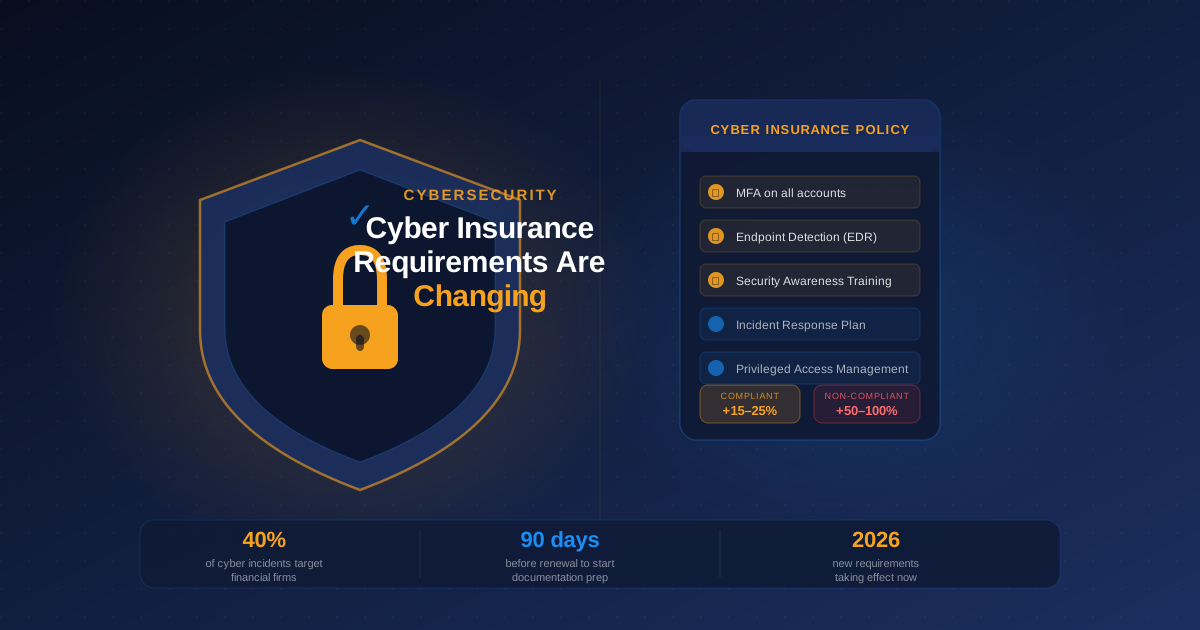
Related reading: Cyber Insurance Requirements Are Changing: What Your Renewal Will Look Like in 2026 →

Renacy is a managed IT support provider serving businesses across New York, New Jersey, Pennsylvania, Connecticut, Massachusetts, Maryland, and Washington DC. Our team specializes in proactive device monitoring, helpdesk support, cloud backup & disaster recovery, and network infrastructure management. Learn more about Renacy →