If your endpoint security strategy is still "we have antivirus," you're defending against a threat model that has been obsolete for the better part of a decade. The attackers who matter — the ones who actually get into mid-sized companies and law firms and healthcare practices — stopped bringing malware to the fight years ago. Antivirus has nothing to scan.
This isn't a marketing claim from an EDR vendor. It's the conclusion every serious incident response team has reached after watching breach after breach unfold the same way: attackers gain access through a stolen password or a phishing message, then operate quietly using the tools already installed on the victim's computer. PowerShell. Windows Management Instrumentation. Scheduled tasks. RDP. None of these are malware. All of them are how modern attacks happen.
The defenses built around "detect the malicious file" have nothing to do in this world. The defenses that matter watch for the behaviors of an attacker operating inside your environment — and that's what EDR, and increasingly XDR and MDR, were built for.
Why Traditional Antivirus Stopped Working
Antivirus, in its classical form, is a signature engine. It maintains a database of known malicious files (or hashes of them) and compares files on the endpoint against that database. If something matches, it gets quarantined. For two decades, this approach was the foundation of endpoint security — and for most of those years, it worked reasonably well.
Three things broke it.
Polymorphic and Custom Malware
Modern malware mutates faster than signature databases can update. A single ransomware family generates thousands of variants — same behavior, different hash. By the time the signature is published, the variant is no longer in use.
Living Off the Land
Attackers stopped writing custom tools because they didn't have to. Every Windows machine ships with PowerShell, WMI, certutil, and bitsadmin — fully capable tools for downloading payloads, executing code, escalating privileges, and moving laterally. Nothing to scan.
Credential-Based Intrusion
The most common initial access in 2026 isn't a malware infection. It's a stolen, phished, or brute-forced credential. The attacker logs in. No file is dropped, no signature is triggered, and the activity looks like a legitimate user — at least until you look closely at what they do once they're in.
Fileless and Memory-Resident Attacks
Some modern malware never touches disk. It executes entirely in memory, leaving nothing for a file-scanning tool to evaluate. The attacker injects code into a legitimate running process and operates from there.
What EDR Actually Does Differently
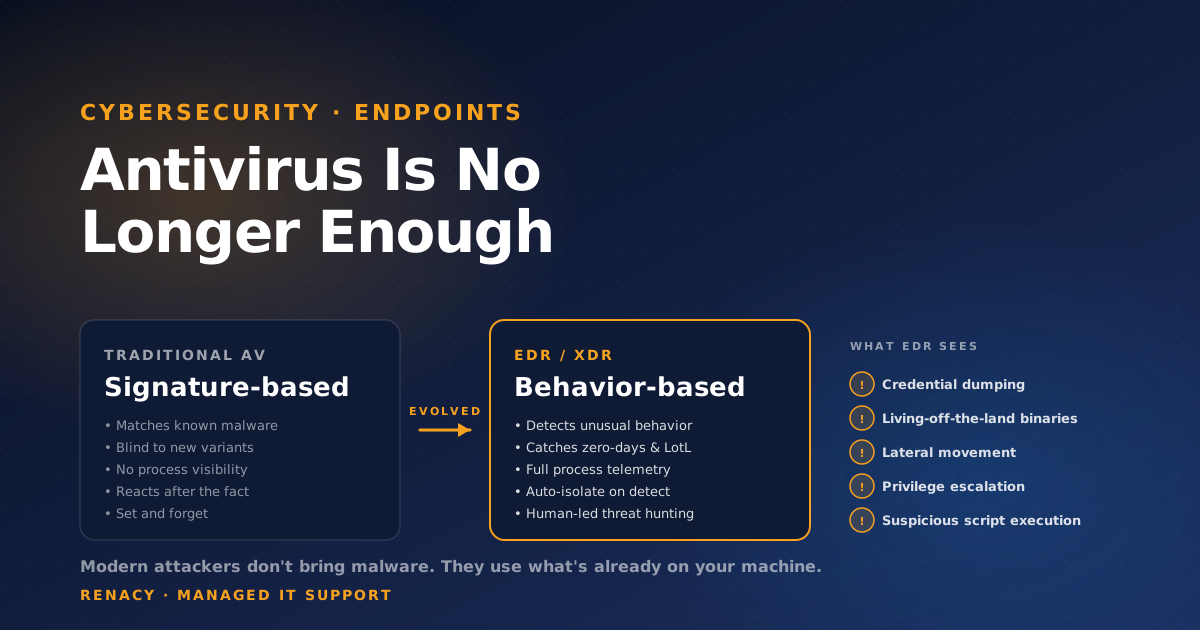
EDR (Endpoint Detection and Response) is built around a fundamentally different question. Where antivirus asks "is this file malicious?", EDR asks "is this activity normal?" It collects high-fidelity telemetry from every endpoint — process executions, network connections, file modifications, registry changes, parent-child process relationships — and applies behavioral analytics to surface anomalies.
The signal EDR looks for is the pattern, not the payload. When PowerShell launches encoded commands at 3 AM from a finance workstation, EDR flags it — even though PowerShell itself is legitimate. When a user account that normally accesses one share suddenly enumerates a hundred, EDR flags it. When a service binary modifies itself to add a new account, EDR flags it.
Antivirus answers "has any file on this machine matched a known-bad signature?" EDR answers "is the behavior of this machine consistent with someone trying to attack it?" The second question is the only one that catches attackers who don't bring their own tools — which is most of them in 2026.
EDR vs XDR vs MDR — The Acronyms That Actually Matter
The endpoint security market generates new three-letter acronyms faster than buyers can absorb them. Three of them matter for a working understanding of the space.
Endpoint Detection & Response
Software deployed on endpoints (workstations, servers, sometimes mobile) that collects behavioral telemetry, runs analytics, and supports response actions like isolating a compromised host. The foundation of modern endpoint security. Examples: CrowdStrike Falcon, Microsoft Defender for Endpoint, SentinelOne.
Extended Detection & Response
EDR extended to additional data sources — email, identity, network, cloud workloads — under a single analytics and response platform. Useful when attacks span multiple systems, which most do. Most major EDR vendors now offer XDR-tier products that bring in non-endpoint telemetry.
Managed Detection & Response
A service wrapping EDR or XDR. A team of human analysts monitors the platform 24/7, triages alerts, investigates incidents, and coordinates response. For organizations without an in-house security operations team — which is most of them — MDR is what turns EDR alerts into actual containment.
The Behaviors EDR Detects That AV Cannot
To make the difference concrete, here are the kinds of activity that show up in modern intrusions — and that traditional antivirus has no mechanism to flag.
| Attacker Activity | Why AV Misses It | What EDR Sees |
|---|---|---|
| Credential dumping (LSASS access) | No malicious file involved | Unusual process accessing memory of LSASS |
| PowerShell with encoded commands | PowerShell is a legitimate Windows tool | Encoded command parameter, unusual parent process |
| Lateral movement via PsExec/WMI | Both are signed Microsoft binaries | Pattern of cross-host process creation |
| Privilege escalation via token theft | No file dropped to disk | Sudden privilege change in a non-admin process |
| Scheduled task persistence | Task creation is normal admin activity | Task running an unusual binary at unusual time |
| Memory-resident shellcode | Nothing written to disk | Memory protection violation, suspicious thread |
| Use of stolen valid credentials | Login is legitimate from AV's view | Anomalous logon time/location/host pattern |
What Insurers Now Expect
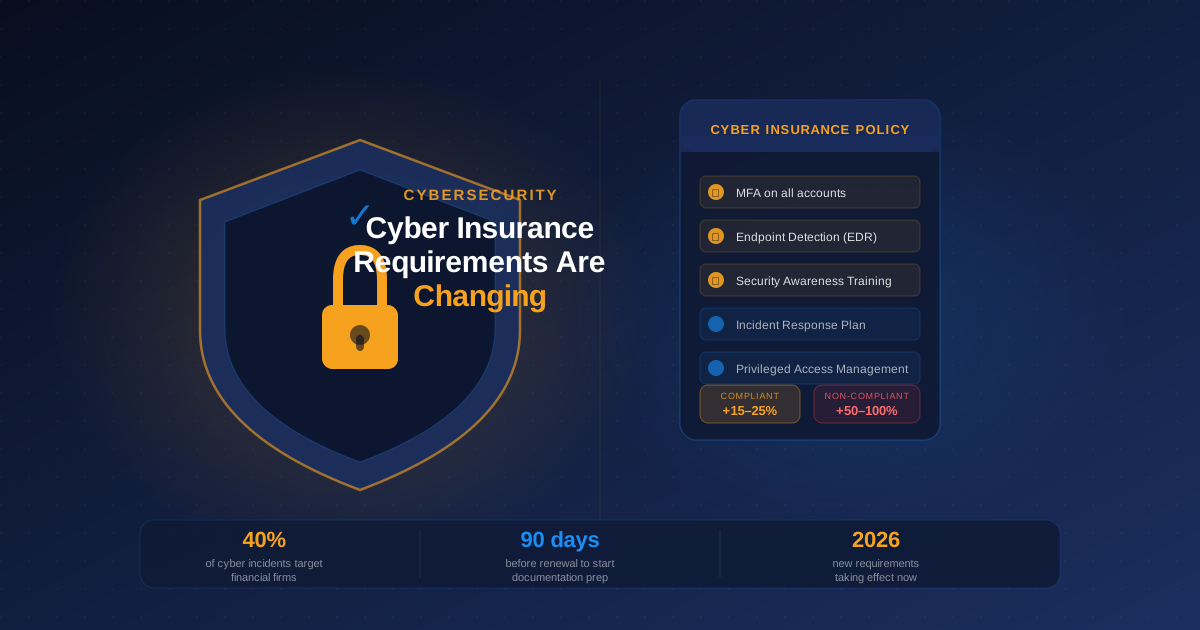
One of the fastest-moving shifts in the cyber insurance market is the explicit requirement of EDR on application questionnaires. We covered the broader trend in our piece on 2026 cyber insurance requirements, but the endpoint security piece is worth pulling out: most major insurers now ask specifically whether you have deployed EDR (often by name) on all endpoints.
Organizations that answer "we have traditional antivirus" are seeing premium increases of 50–100%, sublimit caps on ransomware coverage, or outright denial of new policies. The cost of staying on legacy AV is no longer just security risk — it's a measurable insurance penalty that often exceeds the cost of deploying EDR in the first place.
How to Evaluate What You Actually Need
The right endpoint security configuration depends on the size of your environment, the sensitivity of the data you handle, and the security operations capacity you have in-house. Three patterns cover most mid-sized businesses.
Microsoft 365 Business Premium + Defender for Business
For smaller organizations (under ~300 seats) already on Microsoft 365. Defender for Business provides core EDR capability bundled with M365, with reasonable pricing and tight integration. Pair with MDR if you don't have someone to watch alerts.
Best-of-Breed EDR + MDR Service
For mid-sized organizations or those with stricter compliance requirements. Deploy CrowdStrike, SentinelOne, or similar with a managed detection service. Higher cost, stronger detection, 24/7 human monitoring.
Full XDR Platform
For larger organizations with broad infrastructure (cloud workloads, multiple identity providers, complex email environments). Consolidates endpoint, identity, email, and network telemetry into one analytics platform. Higher operational overhead but much better visibility across the attack surface.
What Not to Do
Don't run legacy AV alongside modern EDR — it creates conflicts, slows endpoints, and leaves gaps neither tool covers cleanly. Don't deploy EDR without a plan for who responds when it generates alerts. Telemetry no one watches is not security.
Frequently Asked Questions
What's the difference between antivirus and EDR?
Traditional antivirus uses signatures — it matches files against a database of known malware. EDR (Endpoint Detection and Response) monitors behavior on the endpoint: which processes run, what they access, how they communicate. AV asks "is this file bad?" EDR asks "is this activity bad?" That difference matters because modern attackers rarely deploy traditional malware — they use legitimate built-in tools like PowerShell, WMI, and PsExec to operate within a victim's environment.
Do we still need antivirus if we have EDR?
Most modern EDR platforms (CrowdStrike Falcon, Microsoft Defender for Endpoint, SentinelOne) include signature-based detection as a baseline component, so a separate AV product isn't necessary. The key is to deploy a single platform that covers both layers rather than running legacy AV alongside EDR — which creates conflicts and gaps.
What is MDR and how does it differ from EDR?
EDR is the technology platform; MDR (Managed Detection and Response) is the service wrapper around it. EDR generates alerts; MDR provides 24/7 human analysts who triage those alerts, investigate, and respond. Most small and mid-sized businesses don't have the in-house security staff to monitor EDR effectively — MDR fills that gap with an outsourced SOC.
What is "living off the land" and why does it matter?
Living-off-the-land (LotL) is the use of legitimate built-in operating system tools — PowerShell, WMI, scheduled tasks, certutil, bitsadmin — to carry out an attack without deploying recognizable malware. Antivirus can't help because there's no malicious file to detect. EDR can detect LotL because it watches the behavior of these legitimate tools and flags unusual usage patterns.
Is cyber insurance requiring EDR now?
Yes, increasingly. Major cyber insurers explicitly list EDR as a required or strongly preferred control on their 2026 application questionnaires. Organizations running traditional AV without EDR are seeing either premium increases, sublimit caps on ransomware coverage, or outright denial of new policies. This was one of the fastest-moving shifts in the cyber insurance market over the past two years.
Related reading: Cyber Insurance Requirements Are Changing: What Your Renewal Will Look Like in 2026 →

Renacy is a managed IT support provider serving businesses across New York, New Jersey, Pennsylvania, Connecticut, Massachusetts, Maryland, and Washington DC. Our team specializes in proactive device monitoring, helpdesk support, cloud backup & disaster recovery, and network infrastructure management. Learn more about Renacy →